
Homepage Uplift
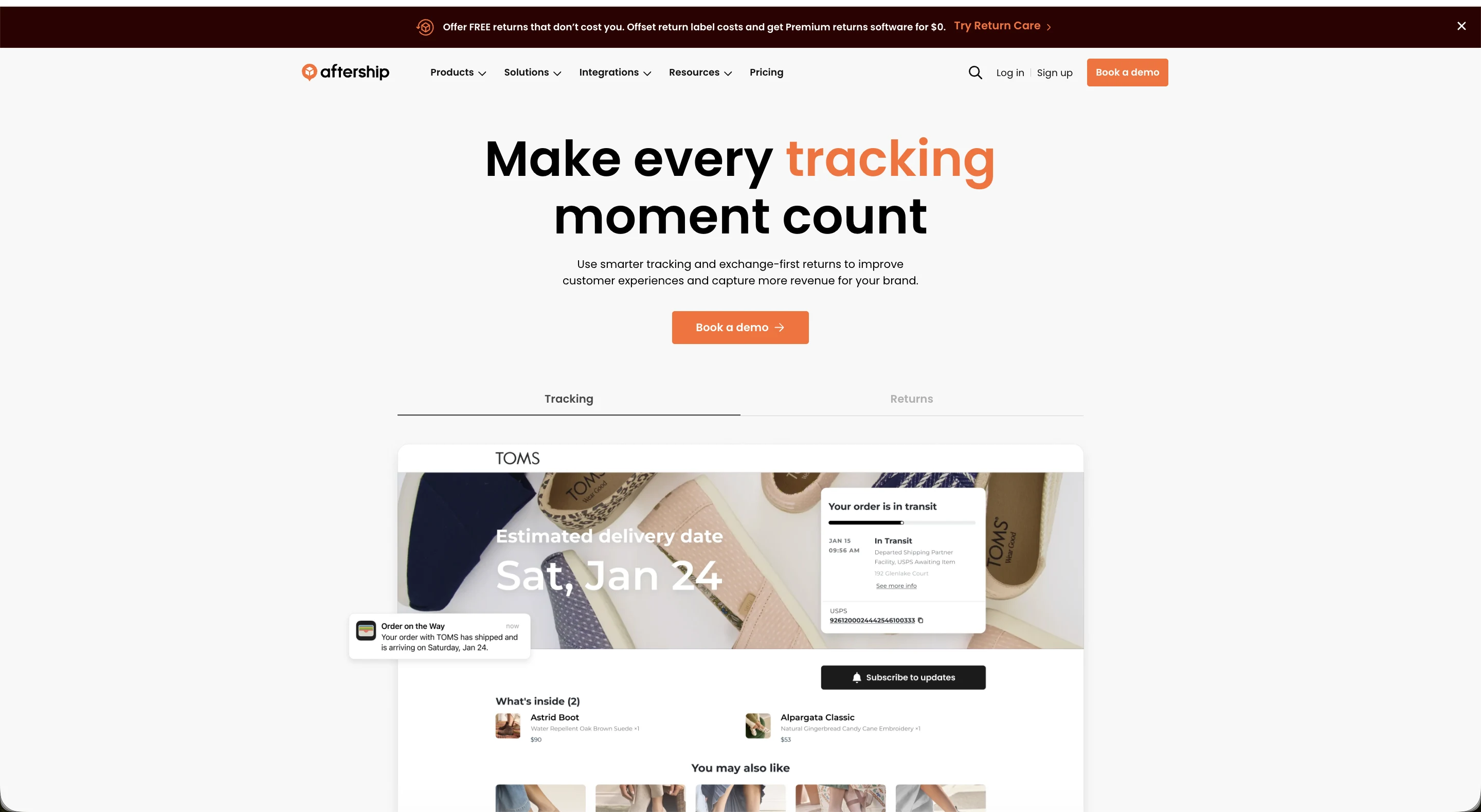
Designed the narrative architecture and section framework for AfterShip's homepage redesign — restructuring the page around a Value → Credibility → Product → Proof → CTA flow to communicate the platform's full value to enterprise buyers in under six seconds.
Context
AfterShip's homepage was underperforming as an acquisition surface. The existing structure prioritised product names and feature lists over the business problems AfterShip solves — making it difficult for enterprise buyers to quickly understand the platform's value or identify where they fit.
The redesign needed to shift the homepage's job from product catalogue to value narrative: arriving visitors should understand who AfterShip is for, why they should trust it, and what it does for their business — before they've scrolled once.
Narrative structure
Five beats. One direction of travel.
Every section of the redesigned homepage serves exactly one job in a five-beat narrative sequence. Visitors move from understanding what AfterShip is, to trusting that others already use it, to seeing what it does, to believing it works, to knowing how to start.
This sequence is not decorative. Each section earns permission for the next. Social proof only lands when the visitor has already formed a hypothesis about value. Testimonials only convert when the visitor has already seen the product. Disorder in the sequence breaks the compounding effect.
Section architecture
Seven sections, each with a single measurable goal.
Hero
Communicate AfterShip's full value in under 6 seconds
Two-column layout: left carries the headline (1–2 lines), a subheadline that names the category and what it unlocks, and a primary CTA. Right carries a product-driven visual. The hero must work as a standalone — a visitor who bounces here should still leave with a clear understanding of what AfterShip does.
Social Proof (above fold)
Build instant legitimacy with enterprise buyers
"Trusted by 20,000+ leading brands" with customer logos and review ratings (G2, Trustpilot, Shopify App Store). Positioned immediately below the hero — sticky with the hero scroll, not buried after product content. 1–3 micro-testimonials to add voice alongside the logo strip.
Problem Section
Show that we understand their operational pain
Three pain blocks laid out horizontally — Visibility Gaps (WISMO volume, inaccurate carrier data), Delivery Issues Go Unnoticed (no shipment-level analytics), Returns as a Cost Center (refund-first workflows, lost revenue). The section headline: "Post-purchase friction is costing you revenue."
Solution Section
Name how we solve the problems above
A single headline + one sentence that bridges the problem section into the product. Direction: "A unified post-purchase solution for retailers — track shipments with industry-leading accuracy, turn returns into revenue, and gain complete operational visibility."
Value Pillars
Establish the 3 core category advantages
Three capability pillars, each leading with what AfterShip does, then the benefit. Capability → benefit ordering reinforces specificity. Generic benefit-first claims ("improve retention") without a capability anchor don't differentiate.
Testimonials / Case Studies
Provide industry-specific social validation
Carousel format filterable by industry vertical. Positioned after value pillars — testimonials are most persuasive when the visitor has already formed a hypothesis about fit. Presenting proof before establishing value inverts the persuasion sequence.
Industries (Future)
Demonstrate cross-vertical applicability
An industry segmentation module — referenced from Dropbox's homepage — that lets visitors self-select into their vertical and see relevant social proof and use cases. Scoped as a future addition once core sections are validated.
Value pillars
Three capabilities. Each one earns its own sentence.
The value pillars section carries the heaviest information load on the page. Each pillar must communicate capability + specific benefit + measurable outcomes — without collapsing into marketing language. The structure: capability name → what it does → what it changes for the business.
Industry-Leading Delivery Tracking
Carrier coverage with faster updates and accurate estimated delivery dates — reducing WISMO tickets and delivering proactive notifications before customers ask.
Revenue-Driving Returns
Exchange-first workflows, incentive layers, and intelligent routing that turn returns from a cost center into a revenue recovery surface.
Delivery Insights & Visibility
Real-time shipment analytics that surface delays, carrier issues, fraud, and CX bottlenecks before they reach the support queue.
Copy framework
Hero copy must clear two tests in sequence.
The hero headline carries the entire first impression of the page. Two copy directions were evaluated against the same criteria: does it communicate the full platform scope, and does it give the visitor a reason to stay?
| Direction | Headline | Assessment |
|---|---|---|
| Platform scope | Operate the post-purchase experience at scale | Names the full scope. "Operate" signals enterprise-grade control. Doesn't lead with a product name or feature. |
| Revenue angle | Turn post-purchase into your most profitable CX channel | Reframes the category from cost to revenue. More provocative for buyers who currently treat post-purchase as overhead. |
Both directions avoid naming specific products in the headline — a deliberate choice. Hero copy that leads with product names ("AfterShip Tracking and Returns") front-loads information that belongs in the value pillar section. The hero's job is orientation, not inventory.
Design references
Each section has a specific interaction reference, not a visual one.
Design references were chosen for specific structural patterns, not visual style. The question for each reference was: what does this site do better than the current AfterShip homepage in this particular section?
Section references
- Klaviyo Hero layout · social proof strip
- Notion Sticky logo bar — moves with hero scroll
- Stripe Proof density above the fold
- HubSpot Social proof + review badge integration
- Webflow Solution section bridge · value pillars · testimonials carousel
- Jasper Solution section copy structure
- ClickUp Problem section tile layout · testimonials format
- Dropbox Industries segmentation module
Design decisions
Four structural choices that shaped the framework.
| Decision | What was considered | Why this direction |
|---|---|---|
| Social proof above fold, adjacent to hero | Social proof after product section; social proof only at the bottom as footer bar | Enterprise buyers scan for legitimacy signals immediately. Proof positioned after product content misses the window where trust most affects bounce rate. |
| Problem section before solution | Lead with solution; lead with product demo; skip problem section entirely | Visitors who recognise their own problem in the page are more receptive to the solution. Skipping the problem section asks buyers to evaluate a solution without first feeling understood. |
| Capability → benefit ordering in value pillars | Benefit-first ("Improve retention") then capability; outcome-first then capability | Benefit-first claims without an anchor are interchangeable with any competitor's page. Capability-first claims are differentiated by definition — no other product does exactly what AfterShip does. |
| Testimonials after value pillars, not before | Testimonials immediately after hero; testimonials interleaved with product sections | Social proof is most persuasive when the reader has formed a hypothesis about fit. A testimonial from a retailer means more after the visitor has seen the tracking and returns capabilities than before. |
A/B test results
The redesign shipped. The numbers moved.
A Statsig-powered A/B test ran across 29,824 visitors after launch. All three primary business metrics improved — with the highest-value conversion signal, homepage to enterprise contact, reaching statistical certainty at greater than 99.9% confidence.
Homepage → Contact Sales
Visitors clicking through to begin enterprise contact — the most direct measure of the redesign's ability to move high-intent buyers further into the funnel.
p > 99.9% · n = 29,824Paid subscription amount
Total subscription revenue attributed to homepage-sourced visitors — a downstream signal that the redesign pulled in higher-value buyers, not just more clicks.
Paid subscription count
Number of paid activations from homepage-sourced visitors during the test window — consistent with the increase in subscription amount.
A +61% lift in contact-sales conversion at greater than 99.9% statistical confidence is not a marginal improvement. It means the narrative architecture — the sequence, the framing, the section order — was the variable that changed buyer behavior at scale.